


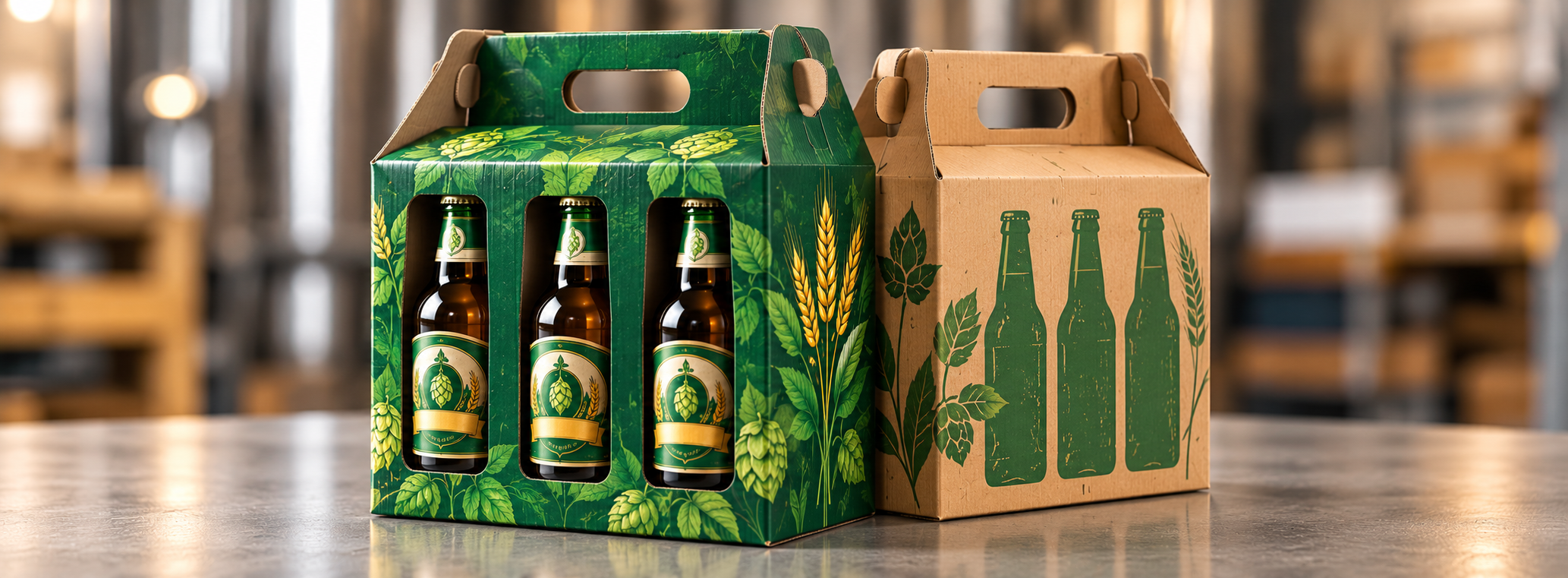
Offset and flexographic printing differ in quality, efficiency, materials, costs, and applications.
Printing technology plays an essential role in the packaging industry, with offset printing and flexographic printing being two of the most widely used methods. Both technologies are used to produce printed materials such as folding cartons, corrugated boxes, labels, and other packaging products.
Although both methods transfer ink onto a substrate, they differ in printing processes, equipment, materials, costs, and applications. Offset printing is known for its excellent image quality, sharp details, and accurate colour reproduction. Flexographic printing, commonly called flexo printing, is valued for its versatility, production speed, and ability to print on different packaging materials.
Understanding these differences helps packaging manufacturers and businesses select the most suitable printing technology based on quality, efficiency, cost, and sustainability.
1. Understanding Offset Printing
Offset printing, also known as offset lithography, is an indirect printing process that transfers an image from a printing plate to a rubber blanket before applying it to the printing surface.
Conventional offset printing operates on the principle that oil-based ink and water repel each other. The printing plate contains image areas that attract ink and non-image areas that repel ink when properly dampened.
The process uses three main cylinders: the plate cylinder, blanket cylinder, and impression cylinder. Together, they transfer the printed image accurately onto paper or paperboard.
One of the greatest advantages of offset printing is its exceptional image quality. It produces sharp text, detailed photographs, smooth gradients, and consistent colours, making it particularly suitable for premium folding cartons and high-quality packaging.
Offset printing is widely used for cosmetics, pharmaceuticals, electronics, food packaging, and luxury consumer products.
However, the process requires printing plates, machine preparation, and colour adjustments, which can increase setup costs for smaller print runs.
For corrugated packaging, offset printing is commonly combined with litho-lamination. This involves printing graphics onto a paper sheet before laminating it onto corrugated board. Although the result offers excellent visual quality, the additional manufacturing stage increases production complexity and costs.
2. Understanding Flexographic Printing
Flexographic printing is a direct printing process that uses flexible photopolymer plates with raised image areas to transfer ink onto a substrate.
Unlike offset printing, flexography transfers ink directly from the printing plate to the material without using an intermediate rubber blanket.
An important component of the process is the anilox roller, which controls the amount of ink delivered to the printing plate. A doctor blade removes excess ink to maintain consistent ink transfer.
Flexographic printing is widely used for corrugated boxes, folding cartons, labels, flexible packaging, and other packaging products.
One of its main advantages is high production efficiency. Flexographic presses can operate at high speeds and are particularly suitable for large-volume packaging production.
The technology also supports different ink systems, including water-based, solvent-based, and UV-curable inks. Water-based inks are especially common in corrugated packaging manufacturing.
Another important advantage is the ability to print directly onto corrugated board, eliminating the need for separate printing and lamination processes.
However, flexographic printing has certain limitations. Flexible printing plates can deform under excessive pressure, potentially affecting fine details and colour reproduction.
Modern developments in digital plate technology, ink control, and high-definition flexographic printing have significantly improved print quality, allowing flexography to compete with offset printing in many packaging applications.
3. Key Differences Between Offset and Flexographic Printing
The main difference between offset and flexographic printing is the method used to transfer ink.
Offset printing uses an indirect process involving a printing plate and rubber blanket, while flexographic printing uses flexible relief plates that transfer ink directly onto the substrate.
Offset printing generally performs exceptionally well on smooth paper and paperboard surfaces, making it suitable for detailed graphics and premium folding cartons.
Flexographic printing is more versatile in terms of substrates and can print on corrugated board, paper, plastic films, and labels.
Another difference involves printing plates. Offset printing typically uses aluminium plates, while flexographic printing relies on flexible photopolymer plates.
In terms of image quality, offset printing has traditionally offered advantages in fine details, photographic images, and smooth colour transitions. However, modern flexographic technology has considerably narrowed this gap.
Production efficiency also differs depending on the application. Flexographic printing can be integrated with corrugated converting operations, while offset printing is frequently used in separate printing and finishing processes.
The most suitable technology depends on packaging requirements, production volume, material characteristics, and desired print quality.
4. Print Quality and Colour Reproduction
Print quality is an important consideration when selecting between offset and flexographic printing.
Offset printing is widely recognised for its ability to reproduce sharp typography, detailed images, and consistent colours. This makes it particularly attractive for premium consumer packaging, where visual appearance contributes to brand recognition and perceived product quality.
Flexographic printing has historically faced challenges with fine details and halftone reproduction because of the flexibility of its printing plates.
However, technological developments have improved its capabilities. High-definition photopolymer plates, advanced screening methods, improved anilox rollers, and automated press controls allow modern flexographic presses to produce detailed graphics.
Both technologies can deliver consistent colour reproduction when supported by effective colour management, appropriate materials, and quality control.
Therefore, print quality depends not only on the printing method but also on equipment capabilities, substrate selection, and production expertise.
5. Applications in Corrugated Packaging
Corrugated packaging is widely used for shipping, storage, retail displays, and e-commerce applications.
Offset printing is commonly used for premium corrugated packaging through litho-lamination. This process allows manufacturers to combine high-quality printed graphics with the protective properties of corrugated board.
It is particularly suitable for retail-ready packaging, promotional displays, and products requiring detailed photographic images.
However, litho-lamination involves additional production stages and materials.
Flexographic printing is widely used for direct printing onto corrugated board. It is especially suitable for shipping boxes, agricultural packaging, e-commerce boxes, and branded transport packaging.
In many factories, flexographic printing is integrated into flexo folder-gluer or rotary die-cutting machines, allowing printing and converting operations to be performed efficiently.
This integration can reduce production time, material handling, and manufacturing costs.
Modern high-quality flexographic systems can also produce attractive retail packaging, providing an alternative to litho-lamination for certain applications.
6. Applications in Folding Cartons
Folding cartons are commonly used for food, cosmetics, pharmaceuticals, electronics, and household products.
Offset printing is widely preferred for premium folding cartons because it provides excellent image quality and detailed graphics.
It is also compatible with finishing techniques such as varnishing, embossing, foil stamping, and protective coatings.
Flexographic printing is another option for folding carton production, particularly in specialised manufacturing environments and high-volume operations.
Its efficiency and compatibility with integrated production systems can make it attractive for certain applications.
The choice between these methods depends on the required print quality, carton material, finishing processes, and production quantity.
7. Production Costs and Efficiency
Production costs are a major factor when choosing a printing technology.
Both offset and flexographic printing require investments in printing plates, inks, equipment, labour, and machine preparation.
Offset printing can be cost-effective for medium- and large-volume production of high-quality paperboard packaging. However, setup requirements may make it less economical for smaller orders.
Flexographic printing can provide cost advantages in large-volume corrugated packaging production, especially when printing is integrated with converting operations.
Direct flexographic printing can also eliminate the additional lamination process required for litho-laminated packaging.
Nevertheless, high-quality flexographic plates can be expensive, particularly for complex designs requiring multiple colours.
Manufacturers should therefore compare total production costs, including materials, setup, waste, printing speed, and finishing operations.
8. Environmental Sustainability
Sustainability is becoming increasingly important in packaging production.
Both printing technologies consume energy, inks, printing plates, and cleaning materials. Their environmental impact depends on the production process, material selection, waste management, and energy efficiency.
Conventional wet offset printing uses dampening solutions, which may contain chemical additives requiring appropriate handling.
Flexographic printing frequently uses water-based inks, particularly in corrugated packaging production. These can reduce reliance on certain organic solvents.
However, water-based inks are not automatically environmentally harmless, and their complete environmental impact must be considered.
Both technologies can improve sustainability through reduced production waste, energy-efficient equipment, responsible material sourcing, and effective recycling practices.
The environmental performance of packaging should therefore be evaluated across its entire lifecycle.
9. Choosing the Right Printing Method
Choosing between offset and flexographic printing requires an evaluation of several factors.
Offset printing is generally a strong choice for premium folding cartons, detailed graphics, and applications requiring excellent photographic reproduction.
Flexographic printing is particularly suitable for corrugated packaging, high-volume production, and applications where direct printing and manufacturing efficiency are priorities.
Production costs, substrate characteristics, print quality, finishing requirements, and environmental considerations should all influence the final decision.
Neither printing method is universally better. The most effective choice depends on the specific requirements of the packaging project.